Chapter 1
“So, Your Highness… would you please marry me?”
I stared blankly at the man who had spoken.
A man was kneeling on one knee before me.
He was beautiful. His pale skin was smooth like porcelain, and his dark hair—tinged faintly with blue—looked as though it held the night sky within it.
Beneath that black hair, brilliant golden eyes gazed straight at me.
His slightly gaunt face and shadowed eyes gave him a strangely decadent allure.
To think he was already this handsome at eighteen. By the time he reached his twenties, he’d probably be a beauty capable of shaking the entire empire.
As I imagined his future, complicated emotions welled up inside me, and I bit my lip hard.
His name was Tristan.
A young duke who had been granted his title not long ago.
And the male lead of this novel.
“Marry you…?”
My voice trembled slightly even though I already knew the answer.
“You mean… you’re asking me?”
At my flustered tone, strength entered Tristan’s gaze.
I tensed like a cat standing before a tiger.
Sometimes Tristan looked at me with an oddly unfamiliar expression—his brows slightly furrowed, his eyes studying my face as if I were a stranger.
Normally, I was comfortable around him, but whenever he looked at me like that, I grew inexplicably nervous and restless.
“Of course. Who else would I propose to, if not Your Highness?”
Tristan’s tone was so resolute that it made me want to run away.
Of course, I liked Tristan. I had liked him for longer than he could ever imagine. More than anyone, I wanted him to be happy.
Which was exactly why this couldn’t happen.
“Tristan… do you love me?”
His brows drew together even more.
Don’t make that face. It’s scary.
It was obvious that Tristan didn’t love me. Otherwise, he wouldn’t glare at me like this every time I said something stupid.
“How many nobles in this empire do you think marry for love?”
Instead of answering my question, he asked one of his own.
He wasn’t wrong. In a world where political marriages were the norm, it wouldn’t be easy for a duke like him to marry someone he loved.
But you do manage to do it. So you can’t compromise here.
“Why are you saying that?”
As I was trying to figure out how to persuade him, Tristan’s voice suddenly turned desperate. My heart nearly stopped.
“You saved me.”
He reached out toward me. I tried to resist, but the moment I saw moisture gather in his golden eyes, I reached out as if enchanted.
He took my hand and pressed it to his cheek, looking up at me with a pleading gaze.
“Are you going to save me… only to abandon me afterward?”
I couldn’t say a word.
I wanted to tell him that I wasn’t his destined partner, that there was someone else he would come to love—but I couldn’t.
So instead, I screamed internally.
What is wrong with him all of a sudden?!
You’re not this kind of character!
And we’re not that close, are we…?!
When did things turn out like this?
This wasn’t how it was supposed to go. Where did it all go wrong?
To explain from the beginning—
One morning, I woke up to find myself inside a novel.
A romance-fantasy novel titled The 13th Princess.
“This can’t be real…”
Unable to believe it, I slapped my own cheek while staring into the mirror.
It hurt. A lot.
It was real.
Tears welled up, though I wasn’t sure whether it was from the pain or sheer shock.
Sniffling, I looked back at the mirror.
A strange young girl stood there—one who looked utterly pitiful.
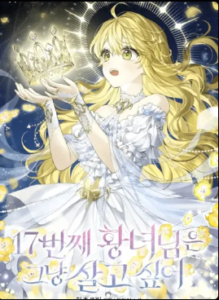
She had long, wavy blonde hair and large, blinking eyes. She could have looked doll-like and cute—
If only she’d gained about ten more kilograms.
She was short and painfully thin, so much so that her dress nearly slipped off her body. Her skin and hair were dull and dry, and there was even a handprint on her cheek.
That handprint was from when I’d just slapped myself, but because she already looked so pitiful, it somehow fit disturbingly well.
She looked like a young Cinderella who had stepped straight out of a fairy tale—radiating misfortune from head to toe.
But contrary to appearances, this girl wasn’t a kitchen maid, a servant, or a beggar.
Her name was Lucillia El Esperusa.
The seventeenth imperial princess of the Esperusa Empire.
“This is a dream!”
Clutching my head, I tried once more to escape reality.
No, it can’t be true. Why, out of all romance-fantasy novels, did it have to be The 13th Princess?!
As the title suggests, The 13th Princess is a political intrigue novel about the thirteenth princess, Imelda, rising to the imperial throne.
Her rivals are, of course, her own siblings—and there aren’t just a few of them.
There are eighteen siblings in total.
Nineteen, including Imelda.
The problem is that despite being a romance-fantasy novel, this story is brutally vicious.
The Esperusa imperial family is, quite simply, insane. Throughout the empire’s long history, not a single succession to the throne occurred peacefully.
Siblings kill each other until only the final victor becomes emperor. That’s the Esperusa tradition.
Calling them a dysfunctional family isn’t nearly enough—this is a blood-soaked lineage.
And I had fallen right into the middle of it.
Not as the protagonist, but as a side character.
“At least Lucillia isn’t the worst case…”
I sighed deeply, recalling the original story.
For some reason, I had not only the knowledge of the novel but also Lucillia’s own memories, so understanding the situation wasn’t difficult.
Lucillia was rare among the Esperusa royals—both physically and mentally weak. Worse still, her mother came from a minor family, leaving her with no powerful relatives to protect her.
Too weak. Too insignificant.
That was what saved Lucillia’s life.
The mad princes and princesses of Esperusa were obsessed with eliminating rivals, but Lucillia was so insignificant that she never even registered as one.
Though weak, Lucillia wasn’t stupid. She knew that this was the only way she could survive.
So instead of getting involved in political struggles, the seventeenth princess chose to live quietly, as if dead, in her small and shabby palace.
After recalling all that, I turned my gaze away from the mirror and looked around.
This was Lucillia’s bedroom. Just as in her memories, it was small and miserable.
There was a bed, a vanity, a palm-sized coffee table with a chair, and a single wardrobe—all of them extremely old.
The blanket on the bed was thin and looked cold. The chair by the table seemed like it might collapse if I sat on it.
By imperial standards, this room was undeniably small and poor.
But from my perspective—
“It’s bigger than my old goshiwon.”
I walked to the window and opened it.
“It even has a window.”
Sunlight poured in through the open window. I couldn’t remember the last time I’d seen sunlight inside my room.
I muttered blankly,
“This room… isn’t bad.”
In my previous life, I’d been born poor.
I couldn’t afford college, so I started working right after graduating high school. After that, I worked myself to the bone. I earned money—some of it, at least.
But instead of spending it on myself, it went to my parents’ living expenses back in the countryside and my siblings’ tuition.
“You’re the eldest daughter.”
That was how my parents comforted me.
It wasn’t gratitude or an apology, but I still found comfort in those words. After all, the only time they spoke kindly to me was when I handed over money.
So I worked harder. I saved every bit I could so I could give more to my family.
I lived in the cheapest room of a goshiwon to save rent and survived on expired convenience-store food.
I’d never had a medical checkup, but living like that, there was no way I could’ve been healthy. My body must have been completely worn down.
Now that I thought about it, I remembered feeling unusually exhausted before falling asleep—far more than usual, as though my entire body were bound in chains.
I must have died from overwork.
“Haha…”
Before I knew it, I was laughing. There was nothing funny, but laughter spilled out anyway.
Looking back, my life really had been pathetic. Working myself to death just to earn money for others—what a hollow way to live.
If I could go back, I’d live differently. No, I would live differently.
But I was probably dead now, forced to live a new life in this insane, unfamiliar world.
The life of a pitiful princess who lived as if she were dead…
“No.”
I suddenly lifted my head and muttered.
This was a novel. Lucillia was a pitiful side character. But her life didn’t remain miserable forever.
I knew Lucillia’s future.
“How old is Lucillia this year…?”
As soon as I murmured it, the answer surfaced in my mind. Imperial Year 515. Lucillia was twelve years old.
“Twelve?”
My eyes traced over my thin arms and legs.
“She looks like she could pass for eight.”
She must have suffered so much that she never grew properly.
It was sad—but the past was the past. What mattered was the future.
Three years from now, Lucillia would meet the person who would change her life forever.
The protagonist of this novel—Imelda.
Imelda had once lived quietly, just like Lucillia.
But when she turned eighteen, a major incident occurred, forcing her into the battle for the throne.
Once she resolved to compete for the crown, Imelda chose a strategy very different from the others.
She sought out the weak and powerless siblings—and extended her hand to them.
Many princes and princesses, frightened or suspicious, rejected her.
But some were moved by her sincerity. They opened their hearts—and were saved.
Lucillia was one of them.
When she was dying from illness, Lucillia survived thanks to Imelda’s help. From that moment on, she vowed to devote the rest of her life to her sister.
That was when Lucillia’s hidden talent awakened.
Using that talent, she supported Imelda.
On the day Imelda became emperor, Lucillia applauded her with a radiant smile—celebrating her sister’s victory, and her own.
By the time I reached that point in my memories, I almost screamed with joy.
This was a total life reversal.
A harsh childhood, then riding the protagonist’s coattails, succeeding at everything, and finally achieving victory over their enemies.
Strictly speaking, the true winner was Imelda—but that wasn’t the life I wanted.
Being emperor sounded exhausting, dangerous, and endlessly burdensome.
Perhaps because I remembered dying from overwork, a life filled with real, quiet happiness—like Lucillia’s—looked far better than ruling an empire.
And now, I was Lucillia.
I stood once more before the vanity and looked at my reflection.
It no longer seemed pitiful.
The figure in the mirror wasn’t a miserable child.
It was a promised happy ending.
Smiling brightly at my reflection, I spoke—to my new self, and to the true protagonist of this world.
“I’ll wait for you, sister.”
Three years until the story begins. Just endure for three years—quietly, as if dead, just as Lucillia always had.
Until the female lead comes to find me.